Options are everywhere in Indian market conversations, from office WhatsApp groups to YouTube thumbnails promising huge returns from tiny amounts. They are also where most retail traders lose the most money. Before you consider trading them, it helps to understand exactly what an option is. This guide explains the basics we cover in our option trading classes in Pune.
We'll go through calls and puts, strike prices, premiums, lot sizes and expiry, the difference between buying and selling options, and the risks you need to respect. No strategies to copy, no tips, just how the contracts work.
- A call gives the right to buy, a put gives the right to sell, at a set price before expiry.
- Option buyers pay a premium. Their maximum loss is that premium.
- Option sellers receive the premium but can face large losses.
- Options lose value as expiry approaches, which is called time decay.
- SEBI studies show most individual F&O traders lose money.
What is an option?
An option is a contract that gives the buyer the right, but not the obligation, to buy or sell something at a fixed price before a set date. In India, the most traded options are on indices like Nifty and Bank Nifty, and on individual large-company shares.
Think of it like paying a small, non-refundable booking amount to reserve a price. If the price moves in your favour, the booking is valuable. If it doesn't, you walk away and lose only the booking amount. That booking amount is called the premium.
Calls and puts
A call option gives the right to buy at a fixed price. Call buyers benefit if the price rises well above that fixed price before expiry. A put option gives the right to sell at a fixed price. Put buyers benefit if the price falls well below it.
For every buyer there is a seller on the other side. The seller receives the premium and takes on the obligation. If the buyer's view is right, the seller loses. This is why the same option can be a small, limited risk for one person and a large risk for another.
Strike price and premium
The strike price is the fixed price written into the option. The premium is what the option costs in the market right now. Options with strikes close to the current price usually have higher premiums, and options far away from it are cheaper.
Cheap options are cheap for a reason. They need a large move to become valuable, and most expire worthless. Beginners often buy them because the small cost feels safe, without realising how rarely they pay off.
Lot size and why it matters
Options in India trade in lots, not single units. One lot of an index option may represent a large quantity of the index, set by the exchange. So even a small change in premium can mean a big change in the money you gain or lose.
Always calculate the rupee value of one lot before placing any trade. Many beginners think in "points" or "premium" and are surprised when a small move costs them thousands of rupees.
Expiry and settlement
Every option has an expiry date. On that date, the option either has value or it doesn't. Index options in India are cash-settled, meaning profits and losses are paid in rupees. Some stock options can involve physical delivery of shares at expiry, which surprises many traders.
Expiry days tend to be busy and volatile. Many beginners are drawn to trading them because premiums are small, but the speed and size of moves on those days make them especially risky.
Time decay: why options lose value
Part of every option's premium is time value, the chance that the price will move before expiry. As expiry gets closer, that time value shrinks. This is called time decay, or theta, and it works against option buyers every single day.
This is why you can be right about direction and still lose money buying options. If the move comes too slowly, time decay eats the premium first.
Volatility and the Greeks, in brief
Option prices also depend on implied volatility, the market's guess of how much prices will move. When uncertainty rises, premiums rise. When it falls, premiums shrink, sometimes even if the price moves your way.
Traders measure these effects with the Greeks: delta for sensitivity to price, theta for time decay, vega for volatility and gamma for how fast delta changes. You don't need to master them on day one, but you do need to know they exist before trading.
In the money, at the money, out of the money
A call option is in the money (ITM) when the current price is above its strike, at the money (ATM) when the price is close to the strike, and out of the money (OTM) when the price is below it. For puts it works the other way round.
ITM options cost more because they already have real value. OTM options are cheaper because they only have time value and need a move to become valuable. Many beginners buy far OTM options for their low price without realising how unlikely they are to pay off.
How to read an option chain
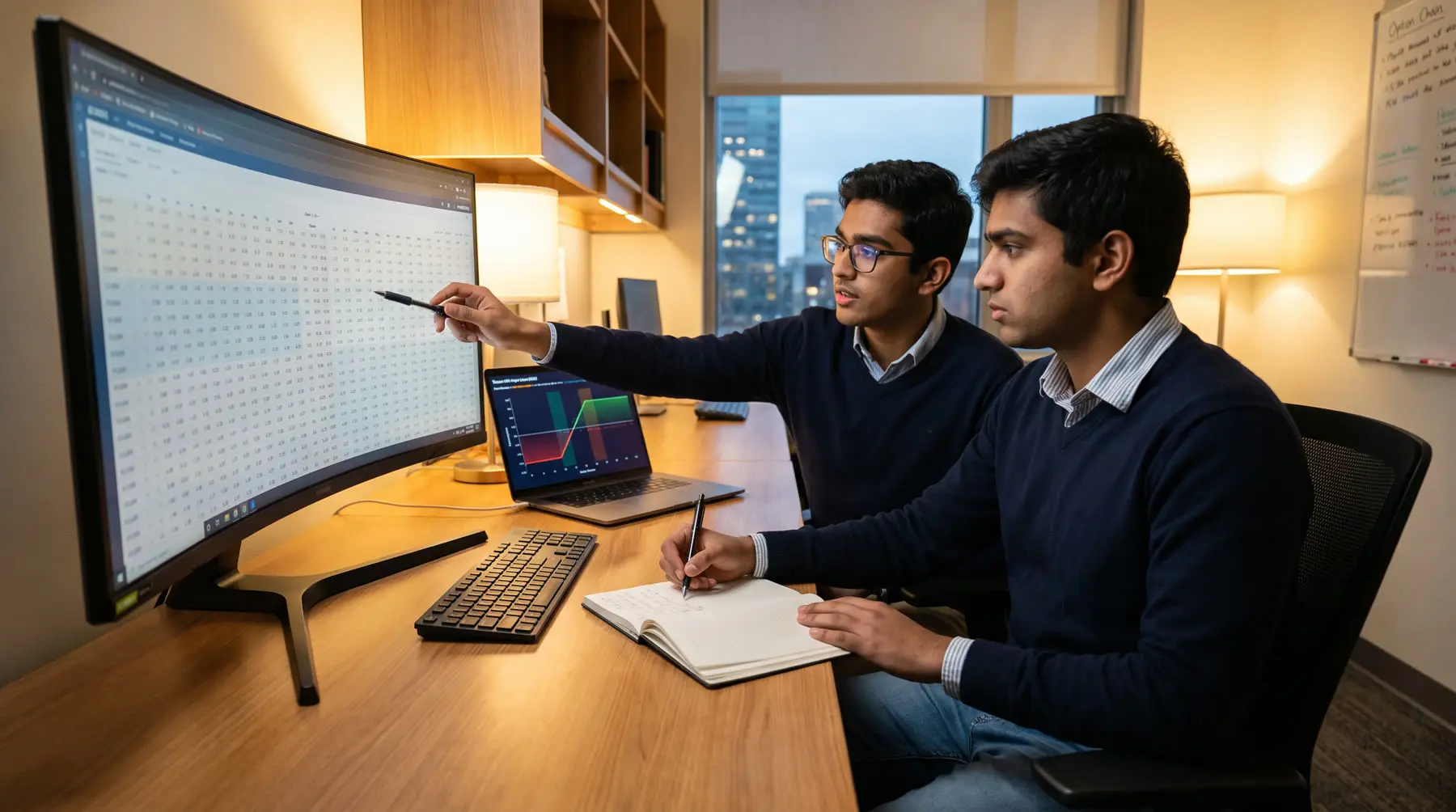
An option chain lists all the available strikes for one expiry, with calls on one side and puts on the other. For each strike you see the premium, the change, volume, open interest and often implied volatility.
Traders use open interest to see where many contracts are open, and implied volatility to judge whether options are expensive or cheap. The chain is full of information, but it is easy to over-read. In our course we study past option chains to see how they actually changed around real events.
A worked example with one lot
Imagine an index option with a premium of ₹100 and a lot size set by the exchange. Buying one lot costs the premium multiplied by the lot size. If the premium rises to ₹150, the gain is ₹50 multiplied by the lot size. If it falls to ₹40, the loss is ₹60 multiplied by the lot size.
Now imagine selling that same option instead. You receive the premium upfront, but if a sharp move pushes the premium to ₹400, the loss is ₹300 multiplied by the lot size, many times what you received. The numbers here are only for illustration, but the shape of the risk is exactly how options behave.
Futures vs options
A futures contract is an obligation to buy or sell at a set price on expiry. Profit and loss move almost one-to-one with the underlying price, and losses can be large on both sides. An option buyer, by contrast, has a right without an obligation, and a maximum loss equal to the premium.
Futures need margin and are simpler to understand in terms of price movement. Options add time decay and volatility to the picture. Our course teaches futures first, because understanding leverage and margin makes options much easier to learn safely.
Buying vs selling options
Buying an option has a limited, known maximum loss: the premium you paid. But the probability of profit is often low. Selling an option gives you the premium upfront and a higher chance of small profits, but a single large move can cause losses far bigger than the premium received.
This is why serious option traders use spreads and hedges, combining bought and sold options so that the maximum loss is defined in advance. Every strategy in our course is taught this way.
Why most F&O traders lose money
SEBI's studies have found that around nine out of ten individual traders in futures and options lose money. The reasons are well known: high leverage, buying cheap options that rarely pay off, overtrading on expiry days, and no fixed maximum loss.
Options are not a shortcut to quick money. They are tools that professionals use carefully, usually for hedging or with strict limits. If you trade them, treat them with the same respect.
How to start learning options safely
Learn market basics and chart reading first. Then learn futures, lot sizes and margin before touching options. Practise on past option chains and paper trades until you can explain any trade's maximum loss before entering.
If you do trade, start with the smallest size, use defined-risk strategies, and never trade money you can't afford to lose. A careful first year teaches far more than a lucky first week.
Common beginner questions
Can I lose more than I invest in options?
When you buy options, your maximum loss is the premium you paid. When you sell options without a hedge, losses can be much larger than the premium you received. That is why option selling needs strict risk management.
What is the minimum amount needed to trade options in India?
Buying options only needs the premium for one lot, but selling options needs much higher margin. The amount varies by contract and changes over time, so check your broker's margin calculator before trading.
Why do cheap out-of-the-money options usually lose money?
They need a large price move before expiry to become valuable, and time decay reduces their value every day. Most of them expire worthless, which is why they are cheap.
Should beginners trade options?
Beginners should first learn market basics, chart reading and futures. Options are an advanced product, and SEBI data shows most individual traders lose money in them. Learn thoroughly and paper-trade before using real money.
What is an at-the-money option?
An at-the-money option has a strike price very close to the current market price of the underlying. Its premium is mostly time value, and it tends to be one of the most actively traded strikes.
What is the difference between futures and options?
Futures are an obligation to buy or sell at a set price, with profits and losses moving closely with the underlying. Options give the buyer a right but not an obligation, with a maximum loss equal to the premium paid.